
The Problem
California families are getting squeezed from every direction.
Housing costs are out of control. Utility bills keep rising. Groceries cost more. Insurance costs more. Child care, gas, and health insurance continue to get more expensive. For too many Californians, it feels harder every year to get ahead.
At the same time, the political establishment keeps asking Californians to pay more while delivering less.
The quickest, simplest, and most direct way to put more money in people’s pockets is for the government to take less out.
Yet today, California’s government is gouging working families and small businesses with some of the highest taxes in America.
California has the highest income tax rate in the nation. The highest statewide sales tax rate. The highest gas tax.
Over the last decade, state spending has roughly doubled.
Yet the results have gotten worse. California now ranks 50th out of 50 states for opportunity in U.S. News & World Report’s Best States rankings. California has the highest poverty rate in America when cost of living is taken into account. California has one of the highest unemployment rates in the nation. California’s highway system ranks 49th out of 50 states overall, and 50th out of 50 for urban arterial pavement condition.
Californians are paying more than ever, yet getting less in return.
California’s 9.3% income tax bracket begins at roughly $72,000 of taxable income for married couples. That rate is higher than the top income tax rate in most states.
The Hilton Plan
Under Steve Hilton’s plan, Californians will pay no state income tax on their first $150,000 of income.
Income above $150,000 would be taxed at a simple 8% rate.
Millions of Californians would see an immediate tax cut and keep more of their own money for housing, childcare, groceries, retirement savings, or whatever matters most to their families.
The result is a tax system that is lower, simpler, and fairer for California families.
What It Means For You
For a married couple filing jointly using the standard deduction and assuming an 8% tax rate on income above $150,000:
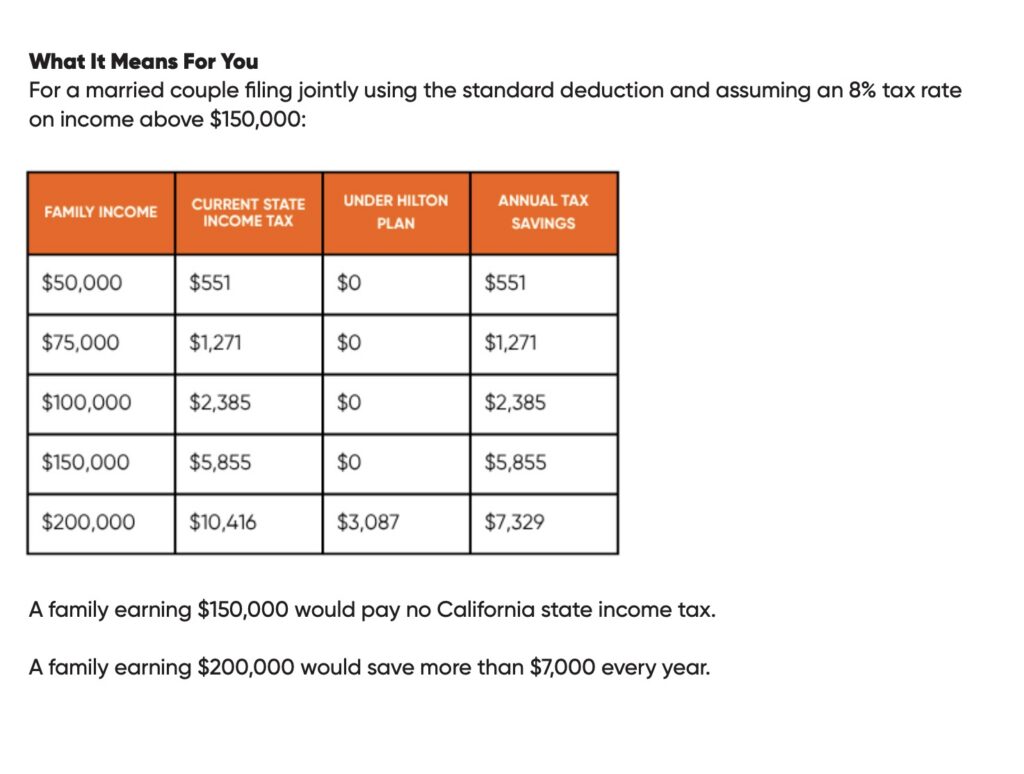
- A family earning $150,000 would pay no California state income tax.
- A family earning $200,000 would save more than $7,000 every year.
Can California Afford It?
Whenever Californians ask for tax relief, the political establishment says there’s no money. Yet California is projected to collect more than $226 billion in General Fund revenue this year.
Independent estimates suggest eliminating state income tax on the first $150,000 of income and applying an 8% rate above that threshold would reduce revenues by approximately $40 billion annually.
That represents roughly a 17.6% reduction in projected General Fund revenues.
The elimination of state income tax on the first $150,000 of income accounts for approximately $20.9 billion of that total, or about 9.2% of projected General Fund revenues.
Even after this tax cut, California would still collect roughly $187 billion in General Fund revenue every year. That is about the same amount the state collected in 2020-21.
At the start of that period, California had roughly 200,000 more residents than it does today. If California could serve a larger population with roughly the same revenue then, it can do so again today.
Californians are not undertaxed.
State spending roughly doubled. Housing costs soared. Utility bills rose. Insurance premiums climbed. California became less affordable. And when the political establishment claims there is no room for tax relief, Californians have every reason to be skeptical.
During the pandemic, California’s Employment Development Department lost an estimated $50 billion to $55 billion in fraud and improper payments. The State Auditor found that EDD did not take substantive action to strengthen fraud detection until months into the pandemic, paid billions in claims it could not verify, and even paid an estimated $810 million in fraudulent claims filed under the names of incarcerated individuals.
California spent nearly $24 billion on homelessness programs over five years. The State Auditor found that state officials could not consistently measure whether the spending actually reduced homelessness.
Before asking Californians to pay more, government should prove it can responsibly manage the money it already receives.
Californians deserve tax relief. State government should learn to live within a budget that was sufficient just a few years ago.
The Bottom Line
Under Steve’s plan, Californians will pay no state income tax on their first $150,000 of income.
Income above $150,000 would be taxed at a simple 8% rate.
For millions of families, that means thousands of dollars every year staying in their household budget instead of going to the government.
California’s affordability crisis won’t be solved by asking families to pay more. It will be solved by letting them keep more of what they earn.